
… or how social media is about information broadcasting
For far too long social media has positioned itself as a tool to keep family and friends connected. I am not sure if that is true anymore. Frankly, I am not sure if that was ever true. (if you think that i am wrong, stop now and tell me why … would love to hear your feedback!)
🌈 I have been thinking about the arc of communications tech — especially in how we communicate with family and friends (and did/will communicate). That arc, in my head, mostly goes like this picture below:
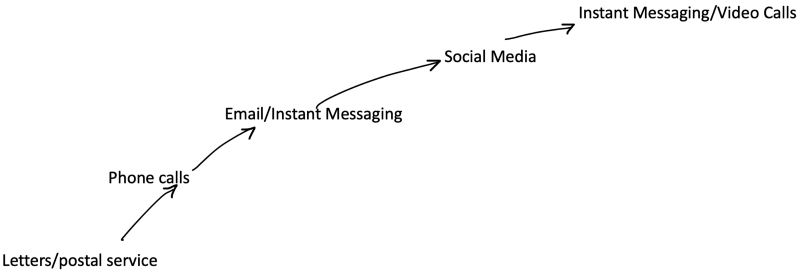
Every piece of tech in the 🌈arc above is designed around solving the problem of connecting two people — except for social media. Unlike, messaging or the phone, social media was always an information broadcasting tool, masquerading as a means to keep in touch with family and friends.
And in doing so, social media never really progressed the arc of personal communications, and I do not see it doing so in the future. There is the talk of the metaverse. But the biggest metaverse use-case so far seems to that of virtual music concerts — that is a far cry from me trying to call grandma on a Sunday to check in on her and listen to her stories about the good ole days of Madras.
But let us digress and walk that 🌈arc for a bit.
📞 ➡ 📧 ➡ 💬 ➡ 🤳
I never really wrote letters to anyone. But I saw my parents move from letter writing to relying on phone calls when keeping in touch with family and friends. With the widespread use of the internet, email and instant messaging (apps like Google Chat/Hangouts) became a commonplace way to keep in touch with friends and family. Of course, instant messaging had its roots in SMS. This combination of phone, email and messaging 📞+📧+💬 gave most folks a good infrastructure to keep in touch with each other.
Eventually internet speeds, and laptop/phone camera qualities improved to a point where video calls became a sustainable means of having a conversation. (Spoke to Dad yesterday over a video call, while he was walking around a park in Chennai 🤳. I would not have thought this possible 2 years ago.)
But amidst all this, came social media.

Social media’s original pitch was that of an effective way to connect with all your family and friends, especially long lost friends. To be fair, that premise — centered around family and friends — was simple, and it worked. I was able to see posts by my uncles, aunts and cousins for the first time — their photos, their jokes 🤣 and their likes and shares. I was able to keep in touch with friends from college. Heck, I even live streamed my wedding on a private Facebook group — and this was well before 2020.
But instead of becoming the fabric that kept communities together, social media has become a substitute for our televisions and radios — they became content creation engines.
And so while they are not solving challenges around personal communications, these content platforms are providing solutions to an entirely different set of problems. They are creating entire industries and jobs that seem exotic to us today, but will likely be economic engines of tomorrow.
Effectively, this does mean that social media is pretty much out of the personal communications business. And not surprisingly people flocked over to apps like WhatsApp, Signal and Zoom in the depths of this pandemic.
One reason that Zoom exists today: Facebook did not think that video calls were worth the trouble. If companies like Facebook and Twitter were really about focused on 1:1 contacts, they would have figured out the business and technology case for video calls. I think the simple truth of the matter is that they are not interested.
If you are still with me, it is worth pondering what the next chapter of communication looks like. Would it be a more immersive experience based on some kind of augmented reality? Would it be a more connected experience that allows us to share more kinds of reactions, files/photos and other forms of multimedia with our friends and family? Can instant messaging be contextually aware about the wedding that you are planing? Can apps like Netflix get in on the action and help us watch movies together even as we are apart? Or will it really be about privacy and trust, where video calling services help us protect the privacy of our children?
The possibilities seem boundless.
I am just glad that social media missed this train.
 Winter Rant
Leave a comment