
It seems unworkable and is likely a cancer to society
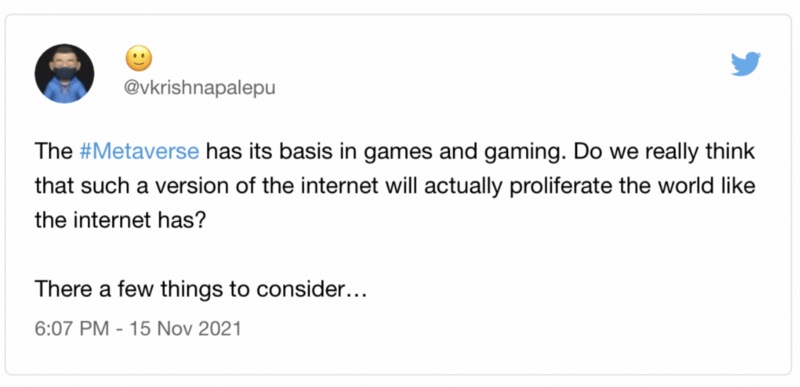
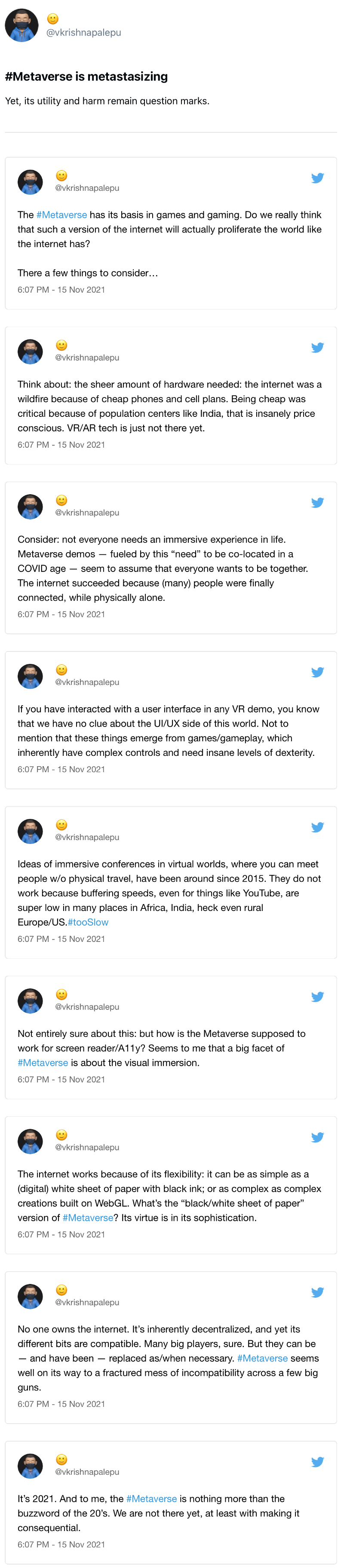
I posted a Twitter thread about the Metaverse a while ago (screenshot of the thread at the end of this article). It was about why the Metaverse is going to be based on fractured and messy technology stacks.
But I never talked about why it will be a cancer to society if it did become real, even in a messy and fractured form.
So, in a first, I am going to expand on my microblog post, with a full blog post.
Information Distortion is a Cancer
Cancer for a living being is an unwanted, foreign-object growth that weakens the body. Cancers don’t just impact human beings, but also other animals: dogs, cats, birds. Just as individual beings — humans, dogs, or cats — I like to think of societies as living organisms.
Social-media-fueled-internet mimics a kind of ‘information cancer’ that debilitates humanity’s ability to agree on basic facts, causes family and friends to fight more often, and gives powerful, malicious actors the ability to inflict real-world harm by using information as a weapon.
The key characteristic of social media that makes it problematic is its ability to distort reality. Think about those instagram filters, or strategically angled selfies. Think about satirical news websites that are effective at making people believe that jokes and satire are often real. Think about how myths like QAnon emerged from the bowels of the internet to cause real harm.
Since the internet continues to present each and every one of us with a custom, bespoke, tailored version of reality, society as a whole cannot agree on basic facts.
Information distortion and conspiracy theories are not new. But the internet has gotten very good at distorting reality for folks looking for meaningful information.
When society faces a high-volume, high-velocity delivery of distorted information, the resulting fractured version of the world becomes embeded in our lived experiences in a way that prevents us from separating fact from fiction.
At minimum, the internet makes separating fact from fiction unreasonably hard.
In the book of information distortion, the Metaverse is the chapter that comes after social-media.
Metaverse is about Make-believe and Distortion
“You can be anything you want.”
“You can meet anywhere you want to.”
“You can attend conferences and concerts with colleagues and friends who are miles away.”
Any Metaverse pitch will sound a lot like the “quotes” above. (For the record, I made them up … but feel free to dispute my basic claim.)
If the Metaverse is going to be this make-believe world, where we are happy to run towards a mythical version of ourselves and away from reality — then the question for me is pretty basic:
If Instagram can cause real psychological harm to teenage girls, and teens in general, with a few photo-filters, what kind of harm are we awaiting when we permit creating entire fake versions of ourselves?
I am truly afraid that there will be a world of psychological research waiting to happen about our own self-image, or self-worth, if/when the Metaverse becomes real and people start using it en masse.
Don’t get me wrong, myth-making and believing in immaginary things is innate to being homo sapiens. In Sapiens, Mr. Harari attributes our success as a species to our ability to believe in myths, i.e., things not present in the physical world. Myths allow us to collaborate and organize in large groups, and succeed as a group. He goes as far as to say that the idea of corporations is a myth that everyone bought into and allowed folks to startup enterprises without the fear of indentured servitude if the startup were to go bankrupt. So, some myths can be beneficial? I think it’s possible. Consider the cloud.
The cloud is a technological ‘myth’ that we buy into: instead of saving files on our local harddrives, we are happy to save them on remote servers, with copies on our machines, because we believe that it is safer that way. Practically, that maybe true. But the cloud is not a physical thing that we can touch or see — the physical servers that store our pictures and documents are far way from us and we cannot access them. Yet, we believe in their utility.
Cost vs. Benefit
I certainly find corporations and the cloud to be meaningful ‘myths’ whose benefits outweigh the risks. So, for me it becomes a cost-benefit question. And I do not like the cost-benefit of Social Media:
Has the world benefitted from Social Media? Yes.
Has the world paid too a high cost for the darker sides of Social Media? Yes.
Would the world today, be better off without Social Media? Probably.
I worry that the Metaverse will have a similar cost-benefit breakdown, with its foundations rooted in social media and gaming, where distortions are the key instruments of communication.
I hope I am wrong. Because like it or not, the Metaverse is coming. Of course, as I call out in my original Twitter thread, I think (and hope) that it will be technologically unworkable.
#FingersCrossed🤞
I like thinking about social media and its utility; and I pull no punches:
https://vkrishnapalepu.medium.com/keep-in-touch-without-social-media-553acec9c290https://vkrishnapalepu.medium.com/keep-in-touch-without-social-media-553acec9c290https://vkrishnapalepu.medium.com/keep-in-touch-without-social-media-553acec9c290
 Winter Rant
Leave a comment